Accurate measurements are at the heart of scientific progress. Whether you work in engineering, chemistry, physics, or environmental science, you rely on correct units to compare data, interpret findings, and publish reproducible research. Yet many students and scholars still perform unit conversions manually, which increases the chance of error and slows down the research process.
Modern online scientific unit converters offer a faster and more reliable alternative.
Why Accuracy Matters in Academic Work
A small mistake in converting temperature, flow rate, density, or concentration can easily affect an entire experiment. In academic writing, such errors may weaken your results or cause your models to fail validation. Since research depends heavily on precision, an online converter can act as an additional layer of quality control.
1. Instant, Error-Free Results
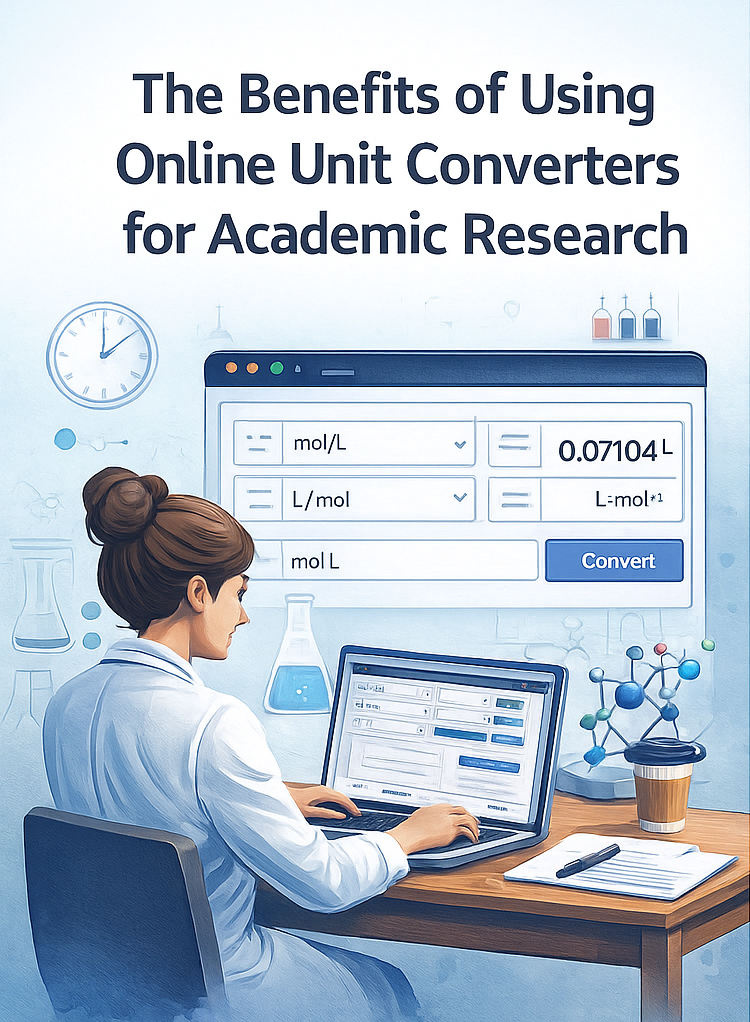
Online converters eliminate the risk of manual arithmetic mistakes. You simply enter a value, choose the units, and get a result with consistent decimal precision. This is especially helpful in subjects where multiple conversions stack together in multi-step calculations.
2. Support for Advanced Scientific Units
General-purpose converters often handle only basic length or temperature units. Scientific research, however, requires converting quantities like viscosity, molar flow rate, radiation dose, magnetic flux, and specific energy. Reliable online converters offer these advanced units, helping students and researchers avoid digging through reference tables.
3. Saves Time During Literature Review and Data Processing
Research papers often use a mix of metric, imperial, and historical units. When comparing two data sets that use different measurement systems, an online converter speeds up the process significantly. This is especially convenient during thesis writing, coursework, or while preparing grant reports.
4. Cross-Disciplinary Flexibility
Academic fields overlap more than ever before. Environmental researchers may use chemical units, physicists may need engineering stress units, and bioengineers may mix thermal and electrical measurements. An online unit converter allows seamless switching between disciplines without searching for conversion constants manually.
5. Helps Improve Reproducibility and Transparency
Research reproducibility depends heavily on clear unit reporting. When everyone uses the same conversion tools, the risk of hidden inconsistencies decreases. Reviewers and collaborators can confidently repeat your calculations because the unit conversions follow standardized rules.
6. Useful for Fieldwork and Lab Environments
Portable online converters are convenient during experiments, field sampling, or on-site measurements. Students can quickly check values on their phones without interrupting their workflow or carrying reference charts.
Conclusion
Online scientific unit converters make academic research more accurate, efficient, and reproducible. They eliminate manual errors, save valuable time, and support a wide range of scientific disciplines. Whether you are writing a thesis, analyzing experimental data, or reviewing literature, a dependable converter is a valuable tool for producing reliable scientific work.