Learning how to convert units in science is an essential skill for students, scientists, engineers, and researchers. A measurement may be given in centimeters when a formula requires meters, in pounds when a calculation requires kilograms, or in degrees Fahrenheit when scientific data is expressed in degrees Celsius.
The safest way to perform these conversions is to use dimensional analysis, also known as the factor-label method.
Dimensional analysis is useful because it allows you to treat units as part of the calculation. Units that are no longer needed cancel, while the required units remain.
What is Dimensional Analysis?
Dimensional analysis is a method of converting a quantity from one unit to another by multiplying it by one or more conversion factors.
A conversion factor is a ratio containing two equivalent quantities.
For example:
1 m = 100 cm
From this relationship, we can write either:
1 m / 100 cm
or:
100 cm / 1 m
Both ratios are equal to one because the numerator and denominator represent the same physical length.
The correct ratio is chosen according to which unit needs to cancel.
Example 1: Converting Centimeters to Meters
Suppose we want to convert:
250 cm to meters
We know:
100 cm = 1 m
Set up the calculation:
250 cm × (1 m / 100 cm)
The centimeters cancel, leaving:
250 × 1 / 100 m
Therefore:
250 cm = 2.5 m
The units themselves help confirm that the calculation has been arranged correctly.
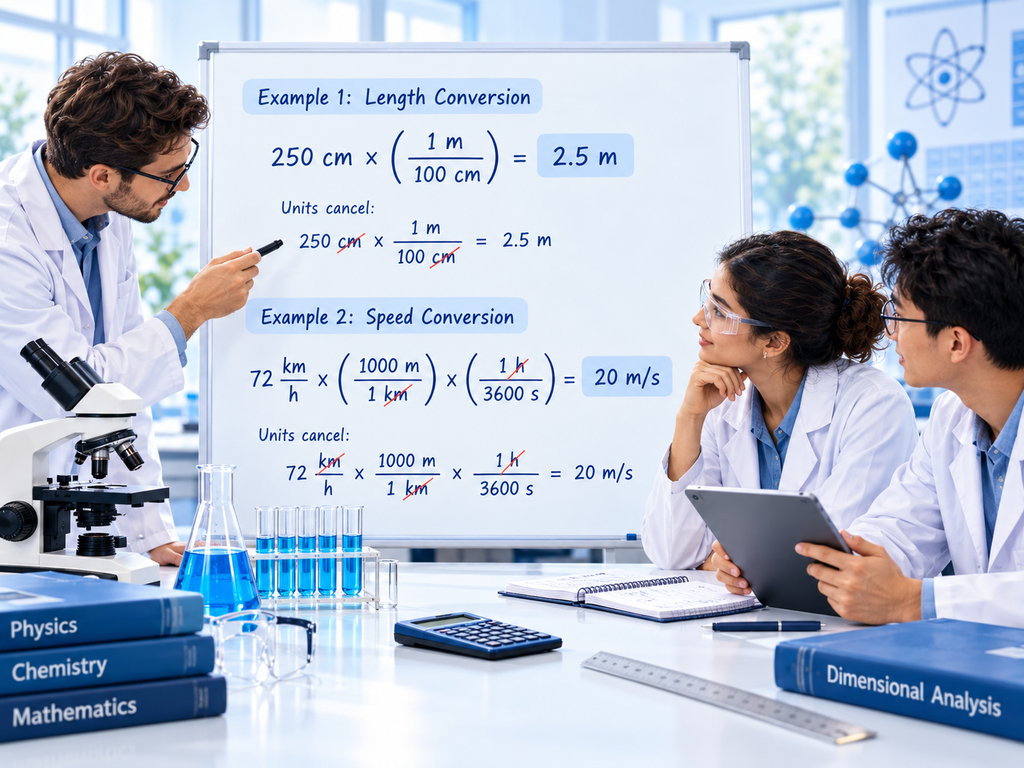
Example 2: Converting Kilometers per Hour to Meters per Second
Unit conversion becomes more interesting when a quantity contains more than one unit.
Suppose a vehicle is moving at:
72 km/h
and we want the velocity in meters per second.
Use:
1 km = 1000 m
and:
1 h = 3600 s
The calculation becomes:
72 km/h × (1000 m / 1 km) × (1 h / 3600 s)
The kilometer and hour units cancel, leaving meters per second.
The result is:
72 km/h = 20 m/s
This illustrates one of the major strengths of dimensional analysis: several conversions can be performed in the same calculation.
Example 3: Converting Grams to Kilograms
Suppose a sample has a mass of:
3750 g
Since:
1000 g = 1 kg
we write:
3750 g × (1 kg / 1000 g)
Therefore:
3750 g = 3.75 kg
Metric conversions are often straightforward because SI prefixes represent powers of ten.
For example:
kilo = 10³
milli = 10⁻³
micro = 10⁻⁶
nano = 10⁻⁹
Understanding these prefixes makes scientific unit conversion much easier. For the official definitions and rules governing SI units and prefixes, see the BIPM International System of Units (SI) Brochure.
Why Units Must Cancel Correctly
A useful rule is:
Never ignore the units while performing the calculation.
If the unwanted unit does not cancel, the conversion factor has probably been placed upside down.
For example, consider converting 5 kilograms into grams.
Correct:
5 kg × (1000 g / 1 kg) = 5000 g
Incorrect:
5 kg × (1 kg / 1000 g)
The second expression does not cancel kilograms correctly and therefore does not represent a valid conversion.
Checking the units before evaluating the numbers can prevent many conversion mistakes.
Converting Squared and Cubed Units
Areas and volumes require special care because the conversion factor must also be squared or cubed.
If:
1 m = 100 cm
then:
1 m² = 10,000 cm²
because:
(100 cm)² = 10,000 cm²
Similarly:
1 m³ = 1,000,000 cm³
because:
(100 cm)³ = 1,000,000 cm³
A common mistake is to convert the numerical value but forget to square or cube the conversion factor.
This can create very large errors, particularly in calculations involving area, volume, density, flow, heat transfer, and other scientific or engineering quantities.
Temperature Conversion Is Different
Not every unit conversion can be performed using a simple multiplication factor.
Temperature scales such as Celsius and Fahrenheit have different zero points, so they require an equation rather than a simple ratio.
For converting Celsius to Fahrenheit:
°F = (°C × 9/5) + 32
For converting Fahrenheit to Celsius:
°C = (°F − 32) × 5/9
For example, to convert 25 °C to Fahrenheit:
°F = (25 × 9/5) + 32
°F = 45 + 32
25 °C = 77 °F
Absolute temperature scales are especially important in scientific and engineering calculations.
Kelvin is related to Celsius by:
K = °C + 273.15
For example:
25 °C = 298.15 K
Temperature conversions are common in thermodynamics, chemistry, heat transfer, process engineering, laboratory work, and many other scientific applications.
Unit Conversion in Scientific Equations
Before inserting values into a scientific equation, it is important to make sure that all quantities use compatible units.
Consider the equation:
distance = velocity × time
Suppose velocity is given in meters per second but time is given in hours.
If the values are multiplied directly, the result will not be a distance in meters.
The time should first be converted from hours to seconds.
For example, if:
velocity = 15 m/s
and:
time = 2 h
then:
2 h × 3600 s/h = 7200 s
Now the distance can be calculated consistently:
distance = 15 m/s × 7200 s
distance = 108,000 m
or:
distance = 108 km
Consistent units are especially important in calculations involving pressure, energy, heat transfer, mass flow, viscosity, density, concentration, and other derived quantities.
How to Convert Units in Science with an Online Converter
Dimensional analysis is important because it helps you understand what a unit conversion means and provides a way to verify that the units have been handled correctly.
For everyday scientific and engineering work, however, manually entering several conversion factors can become time-consuming.
A reliable online converter can perform the numerical calculation quickly while still allowing you to check the result using dimensional reasoning.
You can use the Scientific Unit Converter on this website to convert between scientific and engineering units and compare the result with your manual calculation.
For important laboratory, academic, or engineering calculations, it is still good practice to check that the final dimensions and order of magnitude are reasonable.
Final Thoughts
Dimensional analysis provides a systematic method for converting units in science and engineering.
The basic procedure is:
- Write down the original measurement.
- Identify the required final unit.
- Select the appropriate conversion factor.
- Arrange the conversion factor so that unwanted units cancel.
- Perform the numerical calculation.
- Check that the remaining unit is the one you expected.
- Check whether the order of magnitude of the answer is reasonable.
Once this approach becomes familiar, even complicated scientific unit conversions become easier to understand and verify.
For faster calculations, you can also use the Scientific Unit Converter on this website and compare the result with your dimensional-analysis calculation.