Scientific notation and unit conversion are essential skills in science and engineering because many measurements are extremely large or extremely small. Scientists may work with wavelengths measured in nanometers, microscopic dimensions measured in micrometers, masses measured in milligrams, or astronomical distances expressed using very large powers of ten.
Scientific notation provides a compact way to represent such values, while unit conversion allows the same physical quantity to be expressed in different measurement units.
When these two ideas are used together, calculations become easier to read, compare, check and communicate.
What Is Scientific Notation?
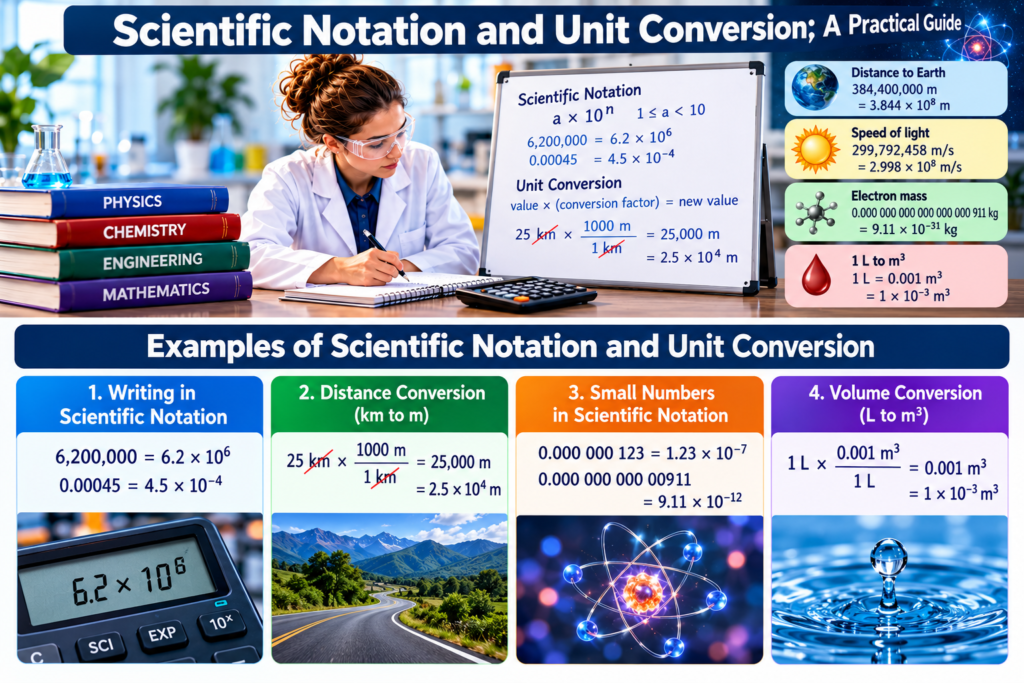
Scientific notation expresses a number in the form:
a × 10ⁿ
where a is normally greater than or equal to 1 but less than 10, and n is an integer.
For example:
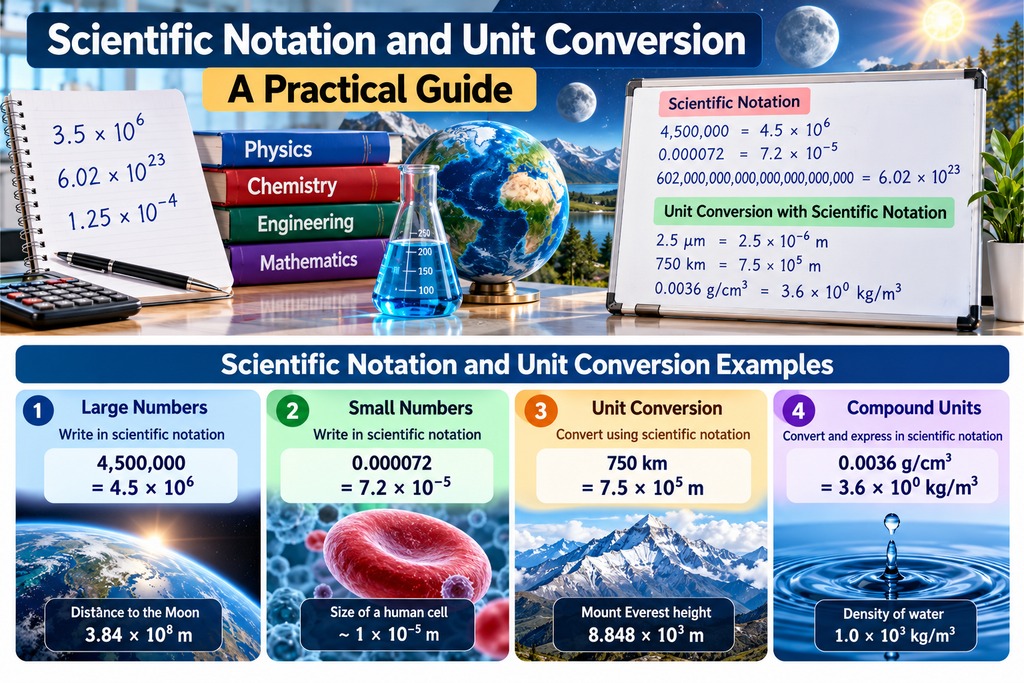
450,000 = 4.5 × 10⁵
and:
0.00032 = 3.2 × 10⁻⁴
A positive exponent represents a large number, while a negative exponent represents a small number.
Scientific notation makes the scale of a measurement immediately visible and helps reduce errors caused by counting long strings of zeros.
How Scientific Notation Relates to SI Prefixes
SI prefixes are closely related to powers of ten.
Some common examples are:
kilo (k) = 10³
mega (M) = 10⁶
giga (G) = 10⁹
milli (m) = 10⁻³
micro (µ) = 10⁻⁶
nano (n) = 10⁻⁹
This relationship makes scientific notation especially useful when converting between metric and SI units.
For example:
5.4 km = 5.4 × 10³ m
because the prefix kilo represents a factor of 10³.
Example 1: Converting Micrometers to Meters
Suppose a microscopic structure has a length of:
25 µm
The prefix micro represents:
10⁻⁶
Therefore:
25 µm = 25 × 10⁻⁶ m
To write the number in normalized scientific notation:
25 × 10⁻⁶ = 2.5 × 10⁻⁵
So:
25 µm = 2.5 × 10⁻⁵ m
Scientific notation makes the scale of the measurement easier to understand than a long decimal representation.
Example 2: Converting Nanometers to Meters
Suppose a wavelength is:
550 nm
Since:
nano = 10⁻⁹
we can write:
550 nm = 550 × 10⁻⁹ m
Now normalize the coefficient:
550 × 10⁻⁹ = 5.50 × 10⁻⁷
Therefore:
550 nm = 5.50 × 10⁻⁷ m
This type of conversion is common in physics, chemistry, optics, spectroscopy and materials science.
Example 3: Converting Milligrams to Kilograms
Suppose a sample has a mass of:
2.5 mg
Milli represents:
10⁻³
Therefore:
2.5 mg = 2.5 × 10⁻³ g
Since:
1 g = 10⁻³ kg
we obtain:
2.5 × 10⁻³ g × 10⁻³ kg/g
which gives:
2.5 mg = 2.5 × 10⁻⁶ kg
Using powers of ten makes the relationship between metric prefixes easy to follow.
Multiplying Numbers in Scientific Notation
When multiplying two numbers written in scientific notation, multiply the coefficients and add the exponents.
For example:
(2 × 10³)(3 × 10⁴)
Multiply the coefficients:
2 × 3 = 6
Add the exponents:
10³ × 10⁴ = 10⁷
Therefore:
(2 × 10³)(3 × 10⁴) = 6 × 10⁷
This rule is useful in scientific formulas involving values that span very different scales.
Dividing Numbers in Scientific Notation
When dividing two values in scientific notation, divide the coefficients and subtract the exponents.
For example:
(8 × 10⁶) / (2 × 10²)
Divide the coefficients:
8 / 2 = 4
Subtract the exponents:
10⁶ / 10² = 10⁴
Therefore:
(8 × 10⁶) / (2 × 10²) = 4 × 10⁴
This rule is particularly useful when conversion factors themselves contain powers of ten.
Watch the Units, Not Just the Exponents
One of the most common mistakes in scientific notation unit conversion is concentrating on powers of ten while overlooking the physical units.
For example:
1 mm = 10⁻³ m
but:
1 mm² = 10⁻⁶ m²
because:
(10⁻³)² = 10⁻⁶
Similarly:
1 mm³ = 10⁻⁹ m³
because:
(10⁻³)³ = 10⁻⁹
This becomes especially important when converting area, volume, density, flow rate and other derived quantities.
The exponent associated with the conversion factor must be raised to the same power as the unit.
Example 4: Converting Cubic Millimeters to Cubic Meters
Suppose we want to convert:
5 × 10⁶ mm³
to cubic meters.
Since:
1 mm = 10⁻³ m
then:
1 mm³ = 10⁻⁹ m³
Therefore:
5 × 10⁶ mm³ × 10⁻⁹ m³/mm³
gives:
5 × 10⁻³ m³
So:
5 × 10⁶ mm³ = 5 × 10⁻³ m³
This example shows why squared and cubed units require special care.
Scientific Notation and Significant Figures
Scientific notation also makes significant figures easier to display.
For example:
4.50 × 10³
clearly communicates three significant figures.
Simply writing:
4500
may be ambiguous because it is not always obvious whether the trailing zeros are significant.
When converting units, the numerical conversion may produce additional decimal places, but the final reported value should reflect the precision of the original measurement.
A unit converter can provide a mathematically precise result, while the scientist or engineer must still decide how many significant figures are appropriate.
How to Convert Scientific Notation with an Online Unit Converter
Scientific notation and unit conversion can be performed manually by tracking powers of ten and conversion factors carefully.
For routine work, however, repeated scientific notation conversions can become time-consuming, particularly when several SI prefixes or derived units are involved.
You can use the Scientific Unit Converter on this website to convert scientific and engineering units and compare the result with your manual calculation.
A reliable converter is especially useful when working with very small or very large values, because it reduces the chance of placing a decimal point in the wrong position.
Related Guide: Dimensional Analysis
Scientific notation becomes even more useful when combined with dimensional analysis.
Dimensional analysis allows conversion factors to be arranged so that unwanted units cancel systematically.
For a detailed explanation with worked examples, see our guide:
How to Convert Units in Science Using Dimensional Analysis
SI Units and Authoritative References
The International System of Units provides the internationally agreed framework for scientific measurement, including SI prefixes and their corresponding powers of ten.
For official SI definitions and prefix conventions, consult the BIPM International System of Units (SI) Brochure.
Common Mistakes to Avoid
Scientific notation is powerful, but several mistakes occur frequently.
- Forgetting whether the exponent should be positive or negative.
- Moving the decimal point in the wrong direction.
- Forgetting to normalize the coefficient between 1 and 10.
- Ignoring the physical unit while manipulating powers of ten.
- Forgetting to square or cube a conversion factor for area or volume.
- Confusing prefixes such as milli, micro and nano.
- Reporting too many significant figures after a conversion.
- Accepting a calculator result without checking whether the order of magnitude is reasonable.
Final Thoughts
Scientific notation and unit conversion are closely connected skills that make very large and very small scientific measurements easier to work with.
Scientific notation provides a compact way to represent very large and very small quantities, while unit conversion allows those quantities to be expressed in the units required for a particular calculation.
The basic approach is:
- Identify the original value and unit.
- Express the relevant SI prefix as a power of ten.
- Apply the correct conversion factor.
- Combine powers of ten using exponent rules.
- Normalize the coefficient if necessary.
- Confirm that the final unit is correct.
- Check the order of magnitude.
- Report an appropriate number of significant figures.
Once these steps become familiar, scientific notation unit conversion becomes much easier to understand and verify.
For faster calculations, you can also use the Scientific Unit Converter on this website and compare its result with your manual scientific-notation calculation.