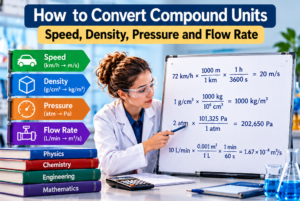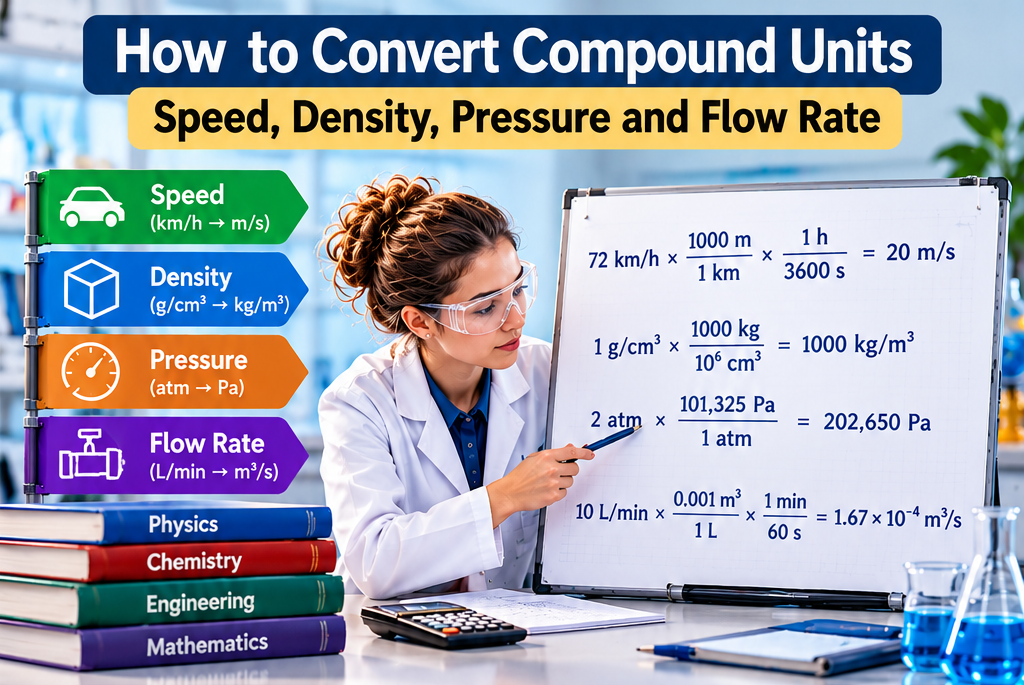
Learning how to convert compound units is essential in science and engineering because many important quantities combine two or more units. Speed may be expressed in kilometers per hour, density in kilograms per cubic meter, pressure in newtons per square meter, and flow rate in liters per minute.
Unlike a simple length or mass conversion, compound-unit conversion often requires converting both the numerator and the denominator. In some cases, squared or cubed dimensions must also be handled correctly.
Dimensional analysis provides a systematic way to perform these conversions while checking that the final units make physical sense.
What Are Compound Units?
A compound unit describes a physical quantity using two or more fundamental units combined by multiplication or division.
For example:
speed = distance / time
which may be written as:
m/s
Density combines mass and volume:
density = mass / volume
with a common SI unit of:
kg/m³
Mass flow rate combines mass and time:
kg/s
Pressure combines force and area:
N/m²
The same principle applies to many other engineering quantities, including heat-transfer coefficients, viscosity, thermal conductivity, energy flux, concentration and diffusivity.
The Basic Rule for Converting Compound Units
The safest way to convert a compound unit is to treat every unit as part of the calculation.
Begin with the original quantity, then multiply by one or more conversion factors so that unwanted units cancel.
For example, if a speed is given in kilometers per hour and the required unit is meters per second, both kilometers and hours must be converted.
The general idea is:
original quantity × conversion factor × conversion factor = required quantity
If the unwanted units cancel correctly and only the desired units remain, the dimensional setup is usually correct.
Example 1: Converting Speed from km/h to m/s
Suppose a vehicle is moving at:
90 km/h
We want to convert this speed to meters per second.
Use:
1 km = 1000 m
and:
1 h = 3600 s
The conversion becomes:
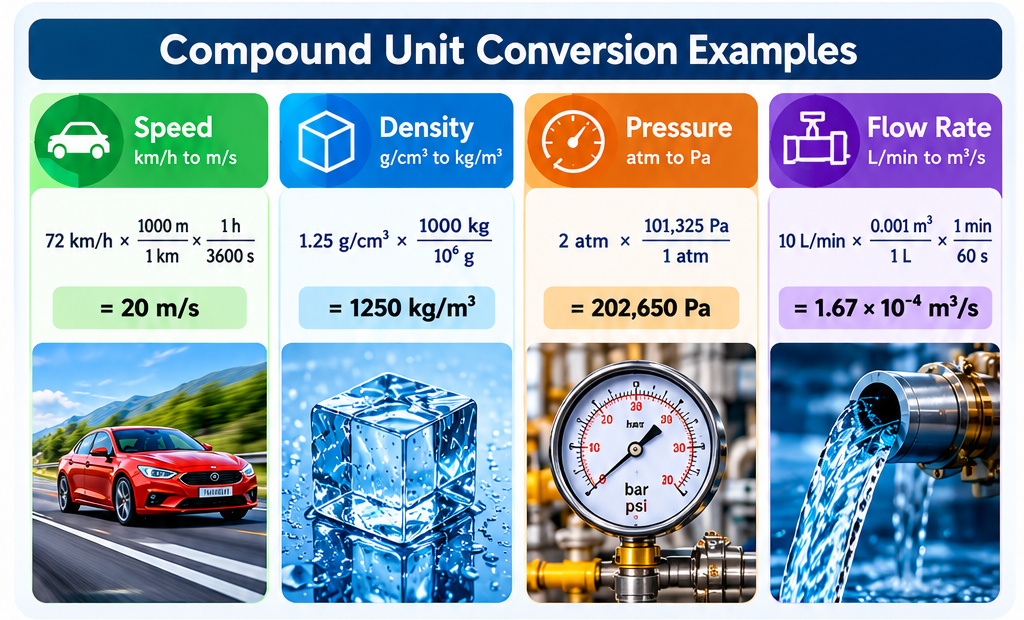
90 km/h × (1000 m / 1 km) × (1 h / 3600 s)
Kilometers and hours cancel, leaving meters per second.
Therefore:
90 × 1000 / 3600 = 25
So:
90 km/h = 25 m/s
This is a classic example of compound-unit conversion because both the distance unit and the time unit must be changed.
Example 2: Converting Density from g/cm³ to kg/m³
Density conversions require special care because volume contains a cubed length unit.
Suppose a material has a density of:
1.2 g/cm³
We want the answer in kilograms per cubic meter.
First:
1 g = 0.001 kg
Also:
1 cm = 0.01 m
Therefore:
1 cm³ = (0.01 m)³
which gives:
1 cm³ = 0.000001 m³
Now convert:
1.2 g/cm³ × (0.001 kg / 1 g) × (1 cm³ / 0.000001 m³)
The result is:
1.2 g/cm³ = 1200 kg/m³
The large numerical change occurs because the centimeter-to-meter conversion is cubed.
Example 3: Converting Pressure from bar to kPa
Pressure is force divided by area.
The SI unit is the pascal:
1 Pa = 1 N/m²
However, pressure is commonly reported in units such as bar, kilopascals, megapascals, atmospheres and pounds per square inch.
Suppose a process operates at:
2.5 bar
We know:
1 bar = 100,000 Pa
Therefore:
2.5 bar = 250,000 Pa
Since:
1000 Pa = 1 kPa
we obtain:
250,000 Pa = 250 kPa
Therefore:
2.5 bar = 250 kPa
Pressure conversions are common in chemical engineering, mechanical engineering, thermodynamics, fluid mechanics, pipelines, pumps and laboratory measurements.
Example 4: Converting Volumetric Flow Rate
Volumetric flow rate combines volume and time.
Suppose a liquid is flowing at:
60 L/min
First convert minutes to seconds.
Since:
1 min = 60 s
we obtain:
60 L/min × (1 min / 60 s)
Therefore:
60 L/min = 1 L/s
Now suppose we want cubic meters per second.
Use:
1000 L = 1 m³
Therefore:
1 L/s × (1 m³ / 1000 L)
which gives:
60 L/min = 0.001 m³/s
This illustrates how several conversion factors can be chained together in a single dimensional-analysis calculation.
Example 5: Converting Mass Flow Rate
Mass flow rate is widely used in process engineering and may be expressed in units such as:
kg/s
kg/h
g/min
lb/h
Suppose a process stream has a mass flow rate of:
3600 kg/h
Since:
1 h = 3600 s
we write:
3600 kg/h × (1 h / 3600 s)
Therefore:
3600 kg/h = 1 kg/s
Mass-flow conversions are especially important in material balances, reactors, separation processes, pipelines and process simulation.
Why Squared and Cubed Units Need Extra Care
One of the most common mistakes in compound-unit conversion occurs when area or volume is involved.
If:
1 m = 100 cm
then:
1 m² = 10,000 cm²
and:
1 m³ = 1,000,000 cm³
The conversion factor must be raised to the same power as the unit.
For example, converting square centimeters to square meters requires squaring the centimeter-to-meter conversion factor.
Likewise, converting cubic centimeters to cubic meters requires cubing it.
This issue is especially important when converting density, volumetric flow, surface area, heat flux and other quantities that contain squared or cubed dimensions.
Common Mistakes When Converting Compound Units
Several errors occur repeatedly in scientific and engineering calculations.
A user may convert the numerator but forget to convert the denominator.
Another common mistake is reversing a conversion factor so that the unwanted unit does not cancel.
Area and volume conversions may also be incorrect if the conversion factor is not squared or cubed.
A useful habit is to write every unit explicitly and cancel units before performing the arithmetic.
If the final unit is not the unit you expected, the dimensional setup should be checked before trusting the numerical answer.
How to Check Whether a Compound-Unit Conversion Is Reasonable
Dimensional consistency is the first check.
The final dimensions should match the physical quantity being calculated.
The second check is the order of magnitude.
For example, converting kilometers per hour to meters per second normally produces a smaller numerical value because one meter per second corresponds to several kilometers per hour.
Density conversions may produce much larger numerical changes because cubic dimensions are involved.
Engineering judgment is therefore useful even when a calculator or online converter is being used.
How to Convert Compound Units with an Online Converter
Manual dimensional analysis is valuable because it shows exactly how the units cancel and helps identify mistakes.
For routine scientific and engineering work, however, repeatedly entering conversion factors can become time-consuming.
A compound unit converter or scientific unit converter can perform the numerical conversion quickly while you use dimensional analysis to verify the result.
You can use the Scientific Unit Converter on this website for scientific and engineering unit conversions and compare its result with your manual calculation.
SI Units and Authoritative References
The International System of Units provides the internationally agreed framework for scientific measurement.
For official SI definitions, prefixes and unit conventions, consult the BIPM International System of Units (SI) Brochure.
Final Thoughts
Compound-unit conversion is based on the same principle as ordinary unit conversion: multiply by equivalent conversion factors until the unwanted units cancel.
The difference is that several units may need to be converted at the same time.
- Write down the original quantity and unit.
- Identify the required final compound unit.
- Separate the numerator and denominator units.
- Choose the necessary conversion factors.
- Arrange the factors so unwanted units cancel.
- Square or cube conversion factors when required.
- Perform the arithmetic.
- Check the final dimensions and order of magnitude.
Once this procedure becomes familiar, conversions involving speed, density, pressure, volumetric flow, mass flow and many other engineering quantities become much easier to understand and verify.
For faster calculations, you can also use the Scientific Unit Converter on this website and compare the result with your dimensional-analysis calculation.