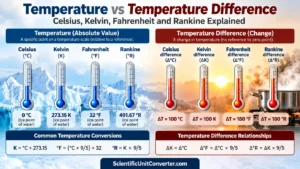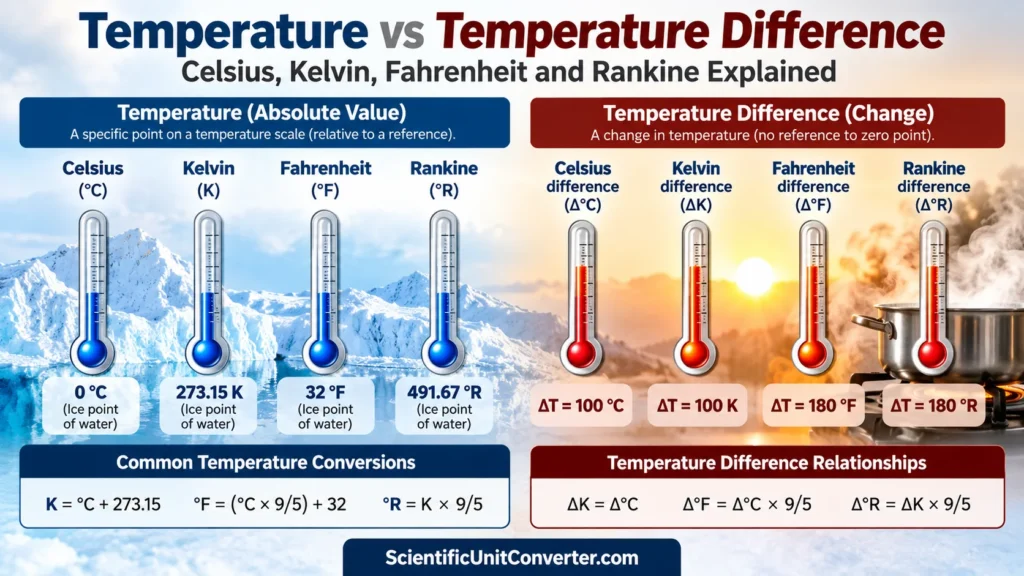
Temperature difference conversion is one of the easiest places to make a serious engineering mistake. A thermometer reading of 25 °C corresponds to 298.15 K, but a temperature rise of 25 °C corresponds to a rise of 25 K, not 298.15 K. The first statement converts a temperature reading; the second converts a change between two readings.
This distinction matters in heat-transfer equations, thermodynamics, process calculations and laboratory reports. Below, we compare Celsius (°C), kelvin (K), Fahrenheit (°F) and Rankine (°R), explain the correct equations, and work through examples that show when to add an offset and when not to.
Temperature vs Temperature Difference: What Changes?
A temperature is a reading on a particular scale. For example, 20 °C, 68 °F and 293.15 K describe the same thermodynamic temperature. The numerical readings differ because the scales have different zero points and, in the case of Fahrenheit, different degree sizes.
A temperature difference, often written as ΔT, is the difference between two temperature readings: ΔT = T2 − T1. An interval has a size but no independent zero-point offset. Subtracting two Celsius readings removes the 273.15 offset between the Celsius and kelvin scales.
| Question | Correct conversion | Why? |
|---|---|---|
| What is 25 °C in kelvin? | 298.15 K | Absolute reading: add 273.15 |
| What is a 25 °C rise in kelvin? | 25 K | Interval: no offset |
| What is a 25 °C rise in °F? | 45 °F | Interval: multiply by 9/5; do not add 32 |
The distinction is consistent with the official SI guidance on Celsius temperature and temperature intervals published by the National Institute of Standards and Technology (NIST).
The Four Temperature Scales Used in Science and Engineering
Celsius (°C)
Celsius is widely used in laboratories, weather reporting and engineering. The size of one Celsius degree is exactly the same as the size of one kelvin. However, the Celsius scale is shifted relative to kelvin by 273.15.
Kelvin (K)
Kelvin is the SI unit of thermodynamic temperature. Its zero is absolute zero, and its unit symbol is K, not “°K.” Use kelvin for absolute temperatures in equations such as the ideal-gas law and for thermodynamic temperature ratios.
Fahrenheit (°F)
Fahrenheit is common in some everyday and industrial settings. A Fahrenheit degree is 5/9 as large as a Celsius degree, so a temperature change of 1 °C equals a change of 1.8 °F. The 32-degree offset applies only when converting temperature readings.
Rankine (°R)
Rankine is an absolute temperature scale with Fahrenheit-sized degrees. It appears in some U.S. customary engineering calculations. Absolute zero is 0 °R; an interval of 1 °R is equal to an interval of 1 °F and to 5/9 K.
Temperature Conversion Formulas for Actual Readings
Use the following equations when the input is a temperature reading, not a change in temperature. These relationships follow the official NIST temperature conversion table and NIST SI conversion guidance.
- Celsius to kelvin: K = °C + 273.15
- Kelvin to Celsius: °C = K − 273.15
- Celsius to Fahrenheit: °F = (°C × 9/5) + 32
- Fahrenheit to Celsius: °C = (°F − 32) × 5/9
- Kelvin to Rankine: °R = K × 9/5
- Rankine to kelvin: K = °R × 5/9
- Fahrenheit to Rankine: °R = °F + 459.67
- Rankine to Fahrenheit: °F = °R − 459.67
These equations convert the same physical temperature into different numerical scales. They do not imply that a temperature interval must receive the same additive offset.
Worked Example 1: Convert 25 °C to °F, K and °R
Suppose a laboratory temperature is 25 °C. First convert to Fahrenheit:
°F = (25 × 9/5) + 32 = 77 °F.
Next convert to kelvin:
K = 25 + 273.15 = 298.15 K.
Finally, convert kelvin to Rankine:
°R = 298.15 × 9/5 = 536.67 °R.
Answer: 25 °C = 77 °F = 298.15 K = 536.67 °R. Each value represents the same temperature reading.
Temperature Difference Conversion Formulas: No Added Offset
For temperature differences, the additive constants disappear. This is the key rule:
- ΔK = Δ°C (same numerical interval)
- Δ°F = (9/5) × Δ°C
- Δ°C = (5/9) × Δ°F
- Δ°R = Δ°F
- ΔK = (5/9) × Δ°R
For example, if one reading is 40 °C and another is 65 °C, the difference is 25 °C, which is also 25 K. In Fahrenheit, the corresponding difference is 45 °F, not 77 °F. Adding 32 to a temperature difference is incorrect.
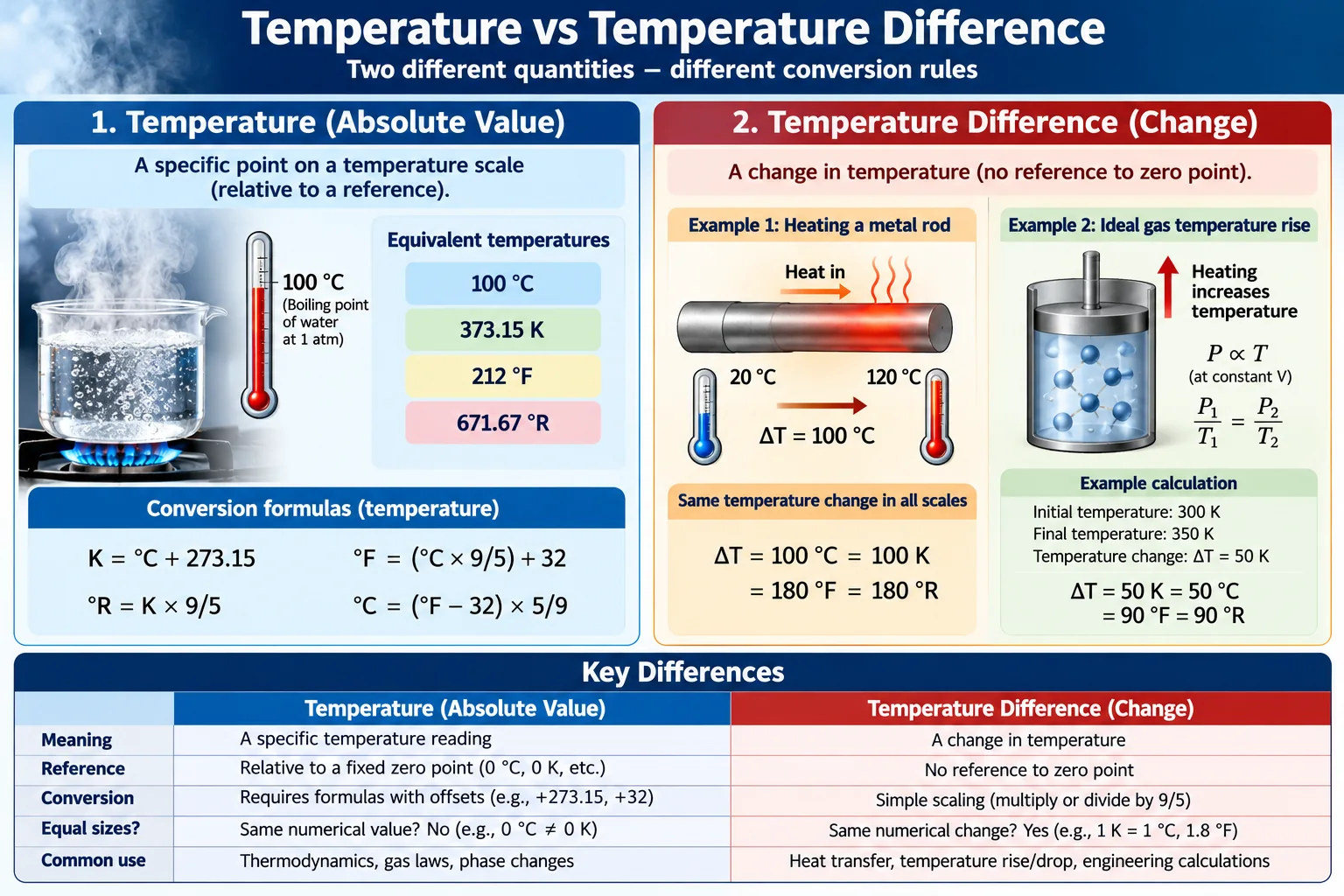
Worked Example 2: A Reactor Warms from 40 °C to 65 °C
The temperature rise is:
ΔT = 65 − 40 = 25 °C = 25 K.
To express that rise in Fahrenheit degrees:
Δ°F = 25 × 9/5 = 45 °F.
As a cross-check, convert the two actual readings: 40 °C = 104 °F and 65 °C = 149 °F. Subtracting gives 149 − 104 = 45 °F. The offset of 32 cancels because it appears in both readings.
Worked Example 3: Convert an 18 °F Temperature Rise to Kelvin
A sensor reports that a process stream warmed by 18 °F. Because this is a difference, do not subtract 32. Convert the interval directly:
ΔK = 18 × 5/9 = 10 K.
The same rise can be written as 10 °C when clearly describing a temperature difference, not an absolute temperature reading.
Why the Distinction Matters in Engineering Equations
Heat transfer: Q = m cp ΔT
In a sensible-heating calculation, heat is proportional to a temperature change. Suppose 2.5 kg of water is heated through 15 °C and a representative constant specific heat capacity of 4.18 kJ/(kg·K) is used for the exercise. The temperature rise is 15 K, not 288.15 K.
Q = (2.5 kg) × [4.18 kJ/(kg·K)] × (15 K) = 156.75 kJ.
Adding 273.15 to a temperature rise would produce a grossly incorrect heat estimate. For a wider range of temperatures or high-accuracy work, account for the temperature dependence of specific heat capacity.
Gas laws: use absolute temperature readings
The opposite rule applies to temperature ratios in gas-law equations. At constant gas amount and volume, ideal-gas pressure is proportional to absolute temperature: P2/P1 = T2/T1. The temperatures must be in kelvin (or another consistent absolute scale), and the pressures must be absolute.
Consider a rigid, sealed vessel containing an ideal gas at 100 kPa absolute and 20 °C. If the gas warms to 80 °C, then T1 = 293.15 K and T2 = 353.15 K:
P2 = 100 kPa × (353.15 / 293.15) ≈ 120.47 kPa absolute.
Dividing 80 by 20 would give the wrong pressure ratio because Celsius has a shifted zero point. For another example of why reference points matter in engineering, read our guide to gauge and absolute pressure.
Quick Reference Table: Readings vs Differences
| Conversion | Temperature reading | Temperature difference |
|---|---|---|
| °C → K | Add 273.15 | Same numerical value |
| °C → °F | Multiply by 9/5; add 32 | Multiply by 9/5 only |
| K → °R | Multiply by 9/5 | Multiply by 9/5 |
| °F → °R | Add 459.67 | Same numerical value |
Common Temperature Conversion Mistakes
- Adding 273.15 to a temperature rise: This converts a Celsius reading to kelvin, not a Celsius interval to a kelvin interval.
- Adding 32 to a Fahrenheit temperature difference: The 32-degree offset cancels when two readings are subtracted.
- Using °C in an ideal-gas temperature ratio: Convert readings to K before forming the ratio.
- Writing °K: The correct SI symbol is K, without a degree sign.
- Confusing an absolute reading with a difference: Label changes as ΔT and specify the units used.
- Ignoring significant figures: Exact conversion constants do not make an uncertain measurement more precise.
For a systematic way to check unit cancellations, see How to Convert Units in Science Using Dimensional Analysis. For a broader discussion of units that combine multiple dimensions, see How to Convert Compound Units.
Using the Scientific Unit Converter Correctly
The Scientific Unit Converter can help you convert supported temperature units. Before entering a value, decide whether it is an actual temperature reading or a difference between two readings. A general temperature converter may apply a scale offset because it assumes you are converting a reading.
- For an actual reading, select the temperature quantity and convert between the supported scales using the displayed formula.
- For a difference, subtract the original two readings first and apply the interval formula from this article.
- Keep the symbol ΔT when documenting a difference, and confirm the result by converting both original readings separately if needed.
- Check whether your engineering equation requires a temperature difference (such as Q = mcpΔT) or an absolute temperature (such as a gas-law ratio).
For help writing very large or small numerical results, see Scientific Notation and Unit Conversion: A Practical Guide.
Frequently Asked Questions
Is a 10 °C temperature change equal to 10 K?
Yes. A temperature difference of 10 °C has the same numerical size as a difference of 10 K. But a reading of 10 °C equals 283.15 K.
How do I convert a temperature difference from Celsius to Fahrenheit?
Multiply the Celsius difference by 9/5. For example, a 12 °C increase equals a 21.6 °F increase. Do not add 32.
Why is kelvin used in gas-law calculations?
Kelvin measures thermodynamic temperature from absolute zero. Gas-law temperature ratios require that absolute reference; using Celsius readings in the ratio introduces a zero-point error.
Is 1 K the same size as 1 °C?
Yes. One kelvin and one degree Celsius represent equal-sized temperature intervals. Their numerical temperature readings differ by 273.15 because their zero points differ.
What is the difference between kelvin and Rankine?
Both are absolute temperature scales. One kelvin is larger than one degree Rankine: 1 K corresponds to 1.8 °R. A temperature of 0 K is also 0 °R.
Final Takeaway
Before any temperature conversion, identify the quantity. A temperature reading may require an offset such as +273.15 or +32. A temperature difference never requires those zero-point offsets; it uses only the relative degree size. That single distinction prevents errors in heat balances, gas laws, laboratory data and engineering calculations.
Authoritative References
- NIST: SI Units – Temperature (exact Celsius, Fahrenheit and kelvin conversion formulas).
- NIST: Guide to the SI, Appendix B.9 (temperature and temperature-interval conversions, including Rankine).
- NIST: SI Brochure, Section 2 (relationship between kelvin and degree Celsius).
- BIPM: The International System of Units, 9th edition (official SI framework, updated in 2026).