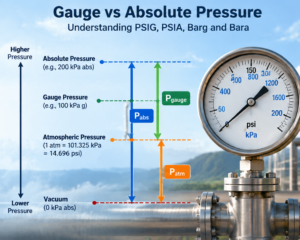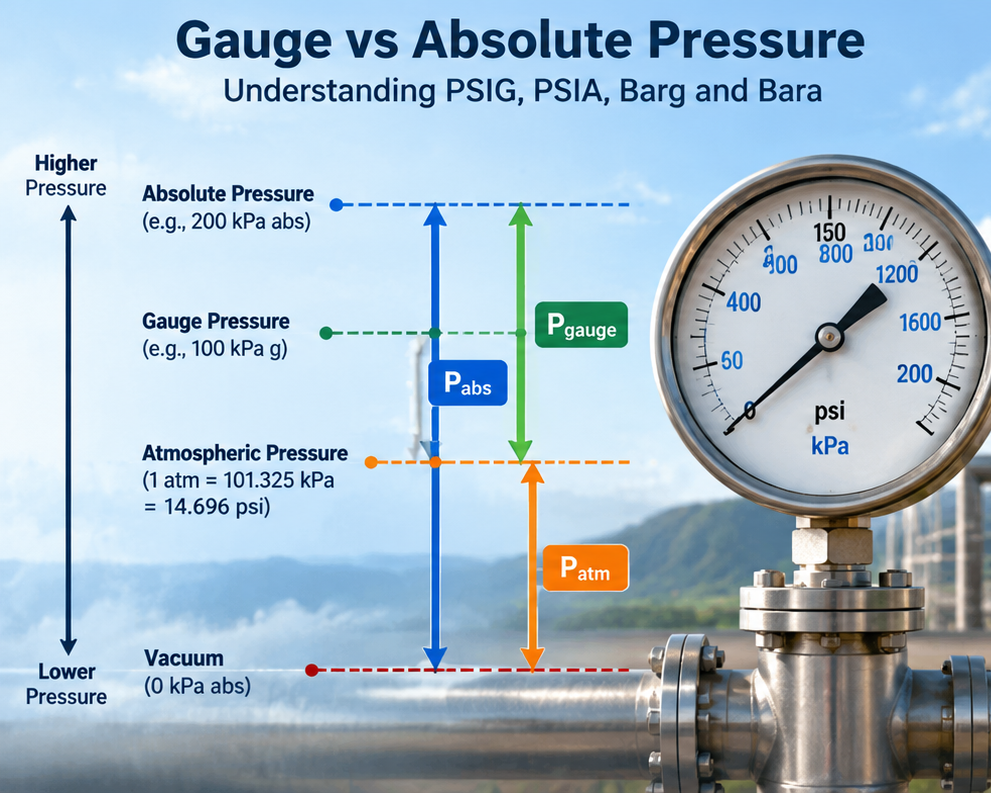
A pressure reading is not fully described by a number and a unit alone. A vessel at 2 bar gauge and a vessel at 2 bar absolute have different physical pressures, even though both readings use bar. The difference is the reference point: gauge pressure is measured relative to the surrounding atmosphere, while absolute pressure is measured relative to a perfect vacuum.
This distinction matters when reading pressure gauges, converting psig to psia, interpreting barg and bara, calculating gas density, or estimating a compressor pressure ratio. The conversion between pressure units is straightforward; converting between pressure references requires an atmospheric-pressure value as well.
In this guide, we will separate those two operations, work through realistic numerical examples, and show how to check a result before using it in a scientific or engineering calculation.
Gauge Pressure vs Absolute Pressure: The Essential Difference
What is absolute pressure?
Absolute pressure is measured from the zero-pressure reference of a perfect vacuum. A reading of 0 kPa absolute represents the ideal vacuum limit. Ordinary gas-law and thermodynamic calculations use absolute pressure because the amount of gas and its state are related to pressure measured from that reference.
Absolute pressure is commonly identified by a suffix or notation such as psia, bara, kPa(a), or simply an explicit statement that the reported pressure is absolute. The suffix clarifies the reference; it does not create a new physical unit.
What is gauge pressure?
Gauge pressure compares the system pressure with the local surrounding atmospheric pressure. A conventional vented gauge reads zero when its sensing port is at the same pressure as the surrounding air. Positive gauge pressure means the system is above local atmospheric pressure; negative gauge pressure means it is below local atmospheric pressure.
Gauge readings are often labeled psig, barg, or kPa(g). A tire gauge or many plant pressure indicators report gauge pressure, but always verify the instrument specification and label before assuming its reference.
What is differential pressure?
Differential pressure is the difference between two selected pressure points. For example, a filter may have a pressure drop of 25 kPa between its inlet and outlet. A differential-pressure instrument compares those two points rather than comparing one point with vacuum or the atmosphere.
When both readings use the same atmospheric reference, subtracting gauge pressures gives the same difference as subtracting absolute pressures. This does not mean that a gauge pressure can be substituted for an absolute pressure in a gas-law equation.
The Formula for Converting Gauge Pressure to Absolute Pressure
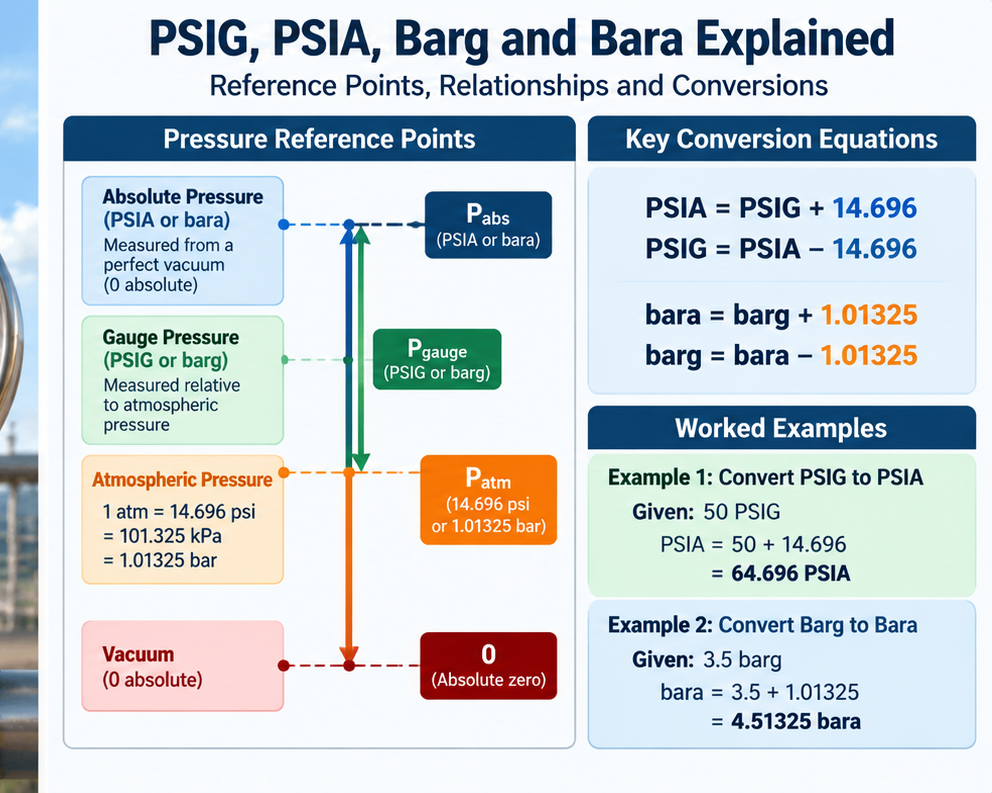
The relationship is:
The reverse calculation is:
All three values must first be expressed in compatible pressure units. The atmospheric term is the local atmospheric pressure at the time and location of measurement, unless a problem explicitly instructs you to assume a standard atmosphere.
For reference, one standard atmosphere is defined as exactly 101,325 Pa, or 101.325 kPa, equivalent to approximately 14.6959 psi. This is a defined reference value, not a promise that the weather or altitude at your measurement location produces that pressure.
NIST: Pressure and Gas Flow Unit Conversions
An immediate consequence is that 0 psig does not mean 0 psia. At standard atmospheric pressure, 0 psig corresponds to approximately 14.6959 psia. Conversely, a system at 0 psia would read approximately −14.6959 psig against that same standard atmosphere.
PSIG vs PSIA and Barg vs Bara: What the Labels Mean
| Label | Meaning | Reference point | Typical use |
|---|---|---|---|
| psig | Pounds per square inch, gauge | Local atmosphere | Tire gauges, many process indicators |
| psia | Pounds per square inch, absolute | Perfect vacuum | Gas properties, absolute-pressure sensors |
| barg | Bar, gauge | Local atmosphere | Process and plant pressure gauges |
| bara | Bar, absolute | Perfect vacuum | Thermodynamics and equipment specifications |
| kPa(g) | Kilopascal, gauge | Local atmosphere | HVAC and industrial instrumentation |
| kPa(a) | Kilopascal, absolute | Perfect vacuum | Gas-law and process calculations |
The letters g and a describe the pressure reference, not a separate conversion factor. Thus, 1 barg and 1 bara each correspond to a numerical magnitude of 100 kPa in their respective references, but they do not describe the same absolute state.
Quick Pressure Conversion Table: Pa, kPa, Bar, PSI and Atmospheres
Once the reference is identified, ordinary pressure-unit conversions can be made with a common base such as the pascal. The table below gives pressure-unit magnitudes; it does not change a gauge reading into an absolute reading.
| Starting magnitude | Equivalent pressure magnitude | Notes |
|---|---|---|
| 1 kPa | 1,000 Pa | Exact SI prefix conversion |
| 1 bar | 100 kPa = 100,000 Pa | Exact definition |
| 1 psi | ≈ 6.894757 kPa | Approximate decimal shown |
| 1 standard atmosphere (atm) | 101.325 kPa = 1.01325 bar | Exact defined reference |
| 1 standard atmosphere (atm) | ≈ 14.6959 psi | Rounded |
| 1 MPa | 1,000 kPa = 10 bar | Exact |
A useful rule is to change the pressure reference first, then change the pressure unit, or do the operations in the reverse order as long as every term is kept consistent. Never add 14.7 directly to a number expressed in bar or kPa.
Related reading: How to Convert Compound Units: Speed, Density, Pressure and Flow Rate
Worked Example 1: Convert 35 PSIG to PSIA and kPa Absolute
A pressure gauge on a compressed-air receiver reads 35.0 psig. The measured local atmospheric pressure is 14.5 psia. Find the receiver pressure in psia and kPa absolute.
Step 1: Add the atmospheric pressure in the same unit
Step 2: Convert psi to kilopascals
Using 1 psi ≈ 6.894757 kPa:
Answer: 49.5 psia, or approximately 341.3 kPa absolute. Notice that we used the stated local atmospheric pressure, not a default of 14.7 psi.
Worked Example 2: Convert 2.50 Barg to Bara
A reactor pressure indicator reads 2.50 barg. Local atmospheric pressure is 99.0 kPa. Calculate the absolute pressure in bara.
Step 1: Convert the atmospheric pressure to bar
Step 2: Add the gauge and atmospheric values
Answer: 3.49 bara, equivalent to 349 kPa(a). If you had assumed 1.01325 bar atmosphere instead, you would obtain a different absolute pressure. The specified local value takes precedence.
Worked Example 3: Negative Gauge Pressure and Vacuum Readings
A vacuum vessel has a gauge pressure of −60 kPa(g), while the local atmosphere is 98 kPa(a). What is the vessel absolute pressure?
Answer: 38 kPa absolute, or 0.38 bara. The minus sign indicates that the vessel pressure is below the local atmosphere. It does not imply a negative absolute pressure.
Some vacuum gauges report a positive vacuum magnitude instead of a negative gauge pressure. For example, a “60 kPa vacuum” indication may mean 60 kPa below the local atmosphere, but instrument conventions vary. Confirm the instrument scale and reference before using such a value.
Worked Example 4: Why Compressor Pressure Ratios Require Absolute Pressure
Suppose a compressor inlet is at 1.0 barg and its discharge is at 5.0 barg. Assume standard atmospheric pressure of 1.01325 bar for this example. Calculate the discharge-to-inlet pressure ratio.
P_inlet,absolute = 1.0 + 1.01325 = 2.01325 bara
P_discharge,absolute = 5.0 + 1.01325 = 6.01325 bara
Step 2: Form the pressure ratio
Pressure ratio = 6.01325 / 2.01325 ≈ 2.987
Answer: The compressor pressure ratio is approximately 2.99, not 5.0. Dividing the two gauge readings (5.0/1.0) would be incorrect because a thermodynamic pressure ratio must use absolute pressures.
The same principle applies to the ideal-gas equation, PV = nRT. If pressure is expressed in gauge units without accounting for the atmospheric offset, the calculated gas state can be wrong even when the numerical unit conversion itself is flawless.
How to Convert Pressure Units with the Scientific Unit Converter
The site’s converter is useful for translating a known pressure magnitude between units such as Pa, kPa, MPa, bar, and psi, provided those units are offered in the pressure menu. However, a general unit conversion by itself does not establish whether the original reading is gauge or absolute.
- Read the instrument or data-sheet label and record whether the value is gauge, absolute, or differential.
- If switching between gauge and absolute pressure, obtain the appropriate local atmospheric pressure and apply the addition or subtraction formula.
- Open the converter and select the pressure quantity, the original unit, and the desired unit.
- Enter the correctly referenced pressure magnitude, perform the unit conversion, and retain the reference label in your final answer.
- Check the order of magnitude and confirm that any gas-law or pressure-ratio calculation uses absolute pressure.
Open the Scientific Unit Converter
For a refresher on arranging conversion factors and checking units, read the site’s dimensional-analysis guide. That article explains the general technique; this page focuses on the separate issue of pressure reference.
Related reading: How to Convert Units in Science Using Dimensional Analysis
Five Pressure-Conversion Mistakes to Avoid
- Treating psig and psia as interchangeable. They share the psi magnitude but use different zero points.
- Always adding 14.7 psi. That approximation describes standard sea-level atmosphere; local atmospheric pressure varies with altitude and weather.
- Mixing pressure units in the offset equation. Convert the atmospheric term to the same unit as the gauge term before adding.
- Using gauge pressure in PV = nRT or a compressor pressure ratio. Use absolute pressure for thermodynamic state calculations.
- Assuming every vacuum display uses the same convention. A negative gauge reading and a positive “vacuum” indication can refer to the same physical condition but use different sign conventions.
For context on why local atmospheric pressure varies, the US National Oceanic and Atmospheric Administration explains air pressure and its changes with elevation and weather.
Frequently Asked Questions
Is 0 psig the same as 0 psia?
No. A gauge reading of 0 psig indicates pressure equal to the gauge’s local atmospheric reference. At a standard atmosphere, that corresponds to approximately 14.6959 psia. Zero psia is the ideal vacuum limit.
How do I convert 100 psig to psia?
Add the atmospheric pressure expressed in psi. Under an explicitly stated standard-atmosphere assumption, 100 psig + 14.6959 psi ≈ 114.6959 psia. Use measured local atmospheric pressure when available.
Does 1 barg equal 1 bara?
No. The numerical unit magnitude is the same, but the reference differs. At 1.01325 bar local atmosphere, 1 barg = 2.01325 bara. A pressure of 1 bara would correspond to approximately −0.01325 barg under that same atmospheric condition.
Can absolute pressure be negative?
In the ordinary pressure measurements discussed here, absolute pressure is referenced to a perfect vacuum and is not negative. Gauge pressure can be negative when the system pressure is lower than the surrounding atmosphere.
What is the difference between pressure conversion and pressure-reference conversion?
Pressure-unit conversion changes the unit, such as bar to kPa, without changing the underlying physical pressure. Pressure-reference conversion changes the zero point, such as barg to bara, and requires the atmospheric-pressure offset.
Final Thoughts
The key to reliable pressure calculations is to keep two questions separate: What unit is the pressure in? and What zero point does the reading use? The first question is answered with ordinary conversion factors. The second is answered by identifying the gauge, absolute, or differential reference.
Before using pressure data in a model, laboratory calculation, equipment specification, or spreadsheet, label the reference explicitly. Then convert the units, apply the atmospheric correction where required, and check the result against the physical situation. This simple discipline prevents errors that a unit converter alone cannot detect.
For authoritative background, consult the pressure-conversion tables from NIST and the discussion of gauge and absolute pressure in OpenStax University Physics.